
JD Vance’s War on Fraud: The Promise and the Problem
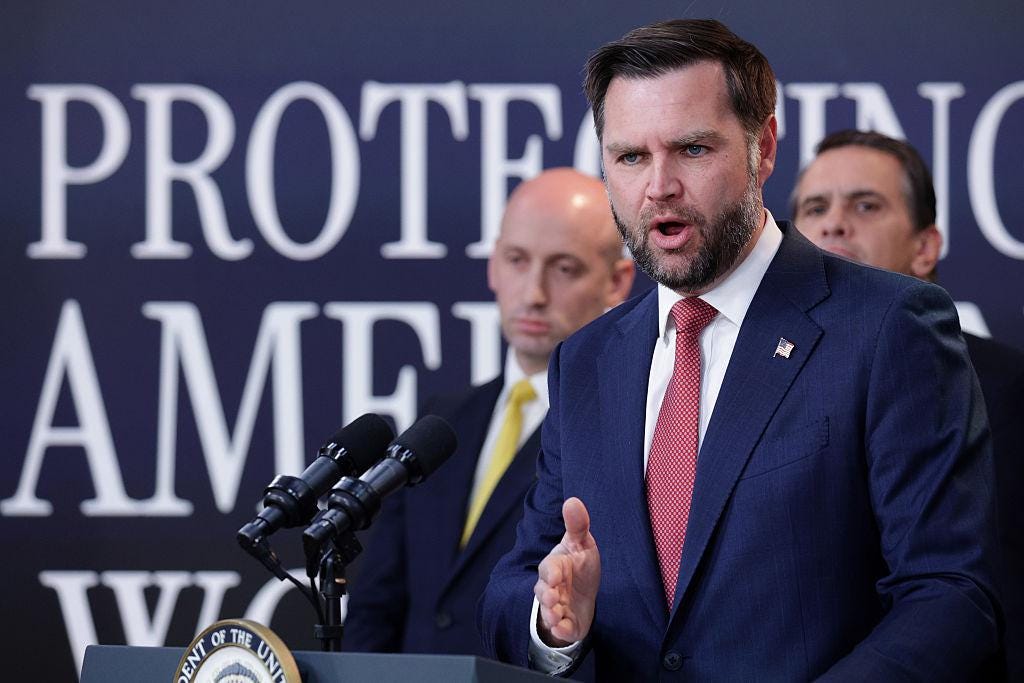
Vice President JD Vance recently unveiled a six-point Pledge to Protect Americans from Fraud, inviting public officials at every level of government to commit to fighting fraud.* I, for one, welcome the attention. Fraud is a serious, longstanding problem that costs hundreds of billions every year and badly erodes the public’s trust in government.
The pledge contains some sound concepts, but it also reveals how much of the administration’s approach remains focused on punishing fraudsters—and immigrants— rather than preventing fraud. And it’s missing a foundational commitment: Measuring whether our government is actually becoming harder to defraud.
Below are the six points, and my reaction to each.
1. Protect vulnerable Americans from fraudsters.
My response: Absolutely. But who are we protecting from what?
Fraud harms vulnerable Americans in myriad ways. Criminals steal their identities, divert their benefits, exploit their trust through scams, and use them as unwitting participants in fraud schemes. And legitimate beneficiaries are harmed when public programs meant to serve them lose money to fraud.
But we should distinguish between fraud against individuals and fraud against government programs. Both are serious problems, but they require different interventions. Protecting Americans from scams demands interventions like consumer education, stronger financial safeguards, and the disruption of coordinated criminal networks. Protecting government programs, on the other hand, requires things like stronger verification mechanisms, advanced data analytics, internal controls, and program oversight.
There is another dimension to protecting vulnerable people that the administration completely overlooks: ensuring that antifraud measures don’t wrongly deny benefits to those who are eligible. A good fraud prevention system needs all of these things.
2. Ensure taxpayer-funded programs serve law-abiding Americans, not undocumented immigrants or fraudsters.
My response: Ineligibility, immigration status, and fraud are different issues, and individuals are not the biggest fraud threat.
Fraud generally involves intentional deception to obtain something of value. Someone can receive an improper payment inadvertently because of an administrative error, misunderstanding, outdated information, or an incorrect eligibility determination. In these situations, no one committed fraud. We need to minimize improper payments, but we mustn’t conflate them with fraud.
Similarly, eligibility rules governing noncitizens vary considerably across federal programs. Some lawfully present noncitizens qualify for benefits under some programs, and certain programs provide limited benefits regardless of immigration status.
Government should verify eligibility accurately and consistently, but the objective should be to ensure that every payment goes to its intended, legally eligible recipient. Conflating immigration status, payment errors, and criminal fraud is simply wrong, and this sort of definitional blurring is damaging to the credibility of serious antifraud efforts.
And importantly, some of the most damaging fraud schemes aren’t perpetrated by individual benefit recipients. Healthcare providers, contractors, grant recipients, businesses, and organized criminal networks all exploit government programs on a massive scale. A national antifraud strategy should prioritize risks based on evidence about where losses occur and how they can be prevented.
**3. Stop fraudsters from using taxpayer-funded benefits to buy mansions and luxury cars.
**My response: Of course. But by the time a fraudster buys a Ferrari, the government has already failed.
This is probably the most politically vivid of the six commitments, but it illustrates a fundamental weakness in how we often talk about fraud. When we focus on what criminals do with stolen money rather than how they were able to steal it in the first place, we miss the opportunity to understand the mechanics of fraud so we can actually stop it.
How did a fraudulent business get approved to receive government funds? How did an excluded provider enroll under a new identity? Why wasn’t a suspicious pattern of payments detected? Why did agencies continue disbursing funds despite warning signs? These are questions about program design, data quality, identity verification, and preventive controls, and they are the questions every government program leader should be asking.
Prosecuting someone who used stolen government funds to buy a sports car is satisfying. But preventing that person from receiving the money in the first place delivers far more value to taxpayers and legitimate beneficiaries.
**4. Coordinate across government to stop fraud before payments go out the door.
**My response: This is the most important commitment in the pledge, and the one I most enthusiastically support.
The administration is spot on with this one. Today’s fraudsters exploit fragmented government systems, weak verification processes, and agencies’ inability to share information or recognize suspicious relationships across programs. It’s far too easy to spin up fake business documents and apply for grants or loans in 15 states and completely evade detection today.
Agencies need timely, affordable access to authoritative data to verify what applicants are attesting. They need modern tools to verify identities, eligibility, business ownership, and other risk indicators. And they need legal authority to intervene when credible evidence suggests a payment may be fraudulent, along with appropriate due process protections.
And, maybe most of all, they need resources. Most federal benefit programs were designed and funded primarily to deliver services, not to combat the sophisticated fraud schemes they face today. Agencies frequently lack the administrative budgets to make the necessary investments that would allow them to prevent and detect fraud before losing billions.
I would love to see this commitment translated into a concrete, government-wide prevention agenda, supported and funded by Congress and backed by measurable performance goals. The administration has already taken steps toward improving verification and data sharing, which are laudable. And several promising antifraud efforts are underway at agencies and states. The Centers for Medicare and Medicaid Services is making great strides in using analytics to cross silos and the Department of Health and Human Services is using advanced analytics to identify risk in its grant programs by evaluating indicators in Single Audit data. Several pilot programs are underway in states across the country looking at ways to improve how states verify eligibility using authoritative source data. These are vitally important efforts, and they should be elevated and used a model for other programs across government.
We also need to recognize that much of the government’s money flows through states, contractors, healthcare organizations, and other intermediaries. These entities should be part of the fraud prevention architecture, with clear responsibilities and appropriate incentives to identify and report suspicious activity before funds disappear.
Congress also needs to do its part. We can’t keep creating programs that depend on applicants truthfully reporting information, deny administrators practical access to the data needed to verify those claims, and then express outrage when fraud occurs. This is a structural problem that requires legislative solutions.
**5. Prosecute, imprison, and permanently bar convicted fraudsters from receiving taxpayer dollars.
**My response: Accountability is essential, but we’re failing to capitalize on the preventive power of the tools we already have.
Fraud prosecutions punish wrongdoing, disrupt criminal networks, and can deter future misconduct. These are all important outcomes, but too often we fail to capitalize on the preventative effects of the systems we have in place today. For example, the federal government already maintains exclusion and debarment systems designed to prevent certain individuals and businesses from participating in federal programs. But these systems are far from foolproof. Individuals can establish new businesses, use associates as nominal owners, change identifying information, or otherwise obscure their connections to previously excluded entities. Modern data analytics and entity-resolution tools offer promising ways to identify these relationships before additional payments are made, but few agencies have these tools today.
At the same time, permanent exclusion from every form of taxpayer funding is an extraordinarily broad proposition that seems unrealistic at best. Existing exclusion and debarment authorities vary by program and offense, and some permit reinstatement after specified conditions are met. The objective should be to prevent demonstrated bad actors from reentering programs through deception, while preserving appropriate legal safeguards and proportionality.
**6. Arrest, prosecute, imprison, and deport undocumented immigrants who commit fraud.
**My response: This commitment largely duplicates the fifth pledge, problematically conflating immigration and fraud.
I believe anyone who commits fraud against government programs should be subject to applicable law. But creating a separate antifraud commitment focused on undocumented immigrants tells us more about the administration’s immigration enforcement priorities than it does about how government intends to prevent fraud. A sophisticated fraud prevention system should identify suspicious activity based on behavior, transactions, relationships, and evidence—not demographic information or immigration status.
The government should be equally concerned about a fraudulent healthcare provider billing Medicare, a contractor misrepresenting its qualifications, a criminal network stealing identities, or an individual intentionally obtaining benefits through deception. In all of these scenarios, the common denominator is fraud. Government fraud prevention systems should be designed to detect it wherever it occurs, not to focus it on certain groups of people.
What I would add to the pledge
I’d add a seventh commitment to the pledge:
We will measure whether government is actually becoming less vulnerable to fraud.
The government is increasingly adept at announcing its commitment to stop fraud, the number of people it has prosecuted, and the value of funds it has recovered. Those are important, but they tell us surprisingly little about whether fraud prevention is improving. Fraud detected, fraud prevented, improper payments identified, and money recovered are different things. Until the government consistently distinguishes among them and reports results using credible, transparent methodologies, we won’t know whether we’re winning the war on fraud or simply getting better at describing it.
There are some important questions the administration should be building a system to answer:
Are agencies identifying and prioritizing their most significant fraud risks
Are they implementing preventive controls that address those risks?
Are those controls demonstrably effective?
Are agencies reducing estimated fraud losses over time?
Are prevention investments producing measurable returns?
Are legitimate beneficiaries receiving timely and fair treatment?
These questions should be central to any national fraud strategy.
The administration deserves credit for making fraud a national priority and for explicitly embracing the principle of prevention before payment. But too much of the rhetoric is punitive and focused on immigration enforcement and not fraud prevention. The real measure of its success will be whether the federal government becomes meaningfully harder to defraud. That is a worthy goal, and one that should transcend politics.
____________
*Vance’s Six Point Pledge
“I pledge to join the fight and do everything in my power to ensure that:
Vulnerable Americans, such as the elderly, indigent, and disabled, are protected from fraudsters who seek to prey on them.
Taxpayer-funded programs serve law-abiding Americans, not illegal aliens or fraudsters.
Taxpayer-funded benefits are not used by fraudsters to buy mansions or luxury cars.
Public agencies and officials work tirelessly and aggressively, coordinating at all levels of government, to stop fraud before payments go out the door.
Fraudsters face justice for their crimes in a court of law. Convicted fraudsters will be imprisoned and barred from ever receiving another penny of taxpayer dollars.
Illegal alien fraudsters are promptly arrested, prosecuted, imprisoned, and deported, never able to take advantage of Americans’ generosity again.
Article first posted on GovIntegrity.